

There's a phone call your service center is fielding right now that never should have happened.
A policyholder's renewal is 30 days out. Their payment method is about to expire, but they never saw the notice in time. So, they call – or forget entirely – and they lapse. Either outcome costs you. One burns agent time and the other burns the relationship.
If you multiply that across your book, you start to understand why service operations are one of the biggest drags on P&C expense ratios. Those calls aren't complicated, but they pile up fast. They exist because your policyholders didn't have information they should have had already.
The answer is a modern policyholder experience — one where policyholders are informed before they have a reason to call and can handle everything else themselves without picking up the phone.
How Carriers Are Running Leaner Service Operations
The carriers that have successfully driven down inbound service volume aren't doing it by accident. They've made a deliberate shift: communication has moved from reactive to orchestrated.
When a renewal is approaching, the policyholder already knows — because they got a timely, personalized notification through the channel they prefer. When a payment is due or a billing event occurs, an automated reminder goes out before uncertainty turns into a call.
When someone needs to make a policy change — add a vehicle, update a lienholder, pull a declarations page — they handle it through a policyholder portal connected to real-time policy data, on any device, without waiting on a CSR.
And on the rare occasion a policyholder does call, the agent already has full context. The interaction is fast, complete, and resolved on the first touch.
That's the operating model carriers are running today — and it's all possible through MyService by ManageMy.
MyService in Action for P&C Carriers
MyService is a purpose-built policyholder servicing solution for P&C carriers. It extends your existing core systems through a configurable, no-code front-end layer — connecting customer experiences, workflows, and data without replacing them.
See MyService in action for your team.
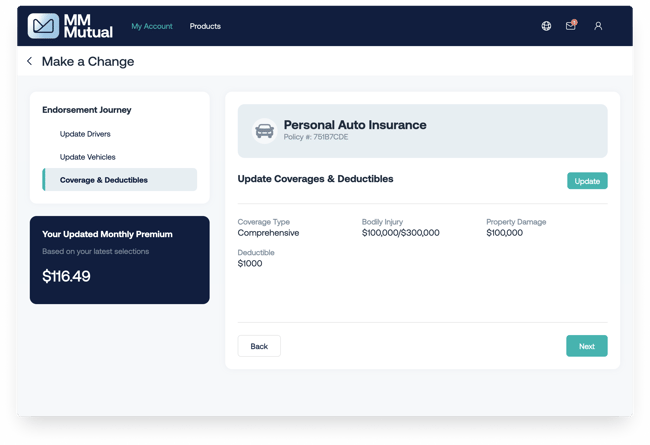
The platform gives carriers control over three things that determine whether service costs stay high or come down:
Proactive, Automated Communication That Eliminates Calls Before They Happen.
Carriers configure triggered messages for renewals, billing events, payment reminders, and servicing milestones — personalized, timed, and delivered through the policyholder's preferred channel. Policyholders get the information they need before they reach out. Agents stay aligned in real time, and lapses driven by billing confusion go down.
Self-Service That Replaces Inbound Call Volume — Not Just Supplements It.
Policyholders get a single destination to view policy details, request endorsements, upload documents, manage payments, and access billing history — without calling in or waiting on email. Carriers define exactly what actions are available by policy type, product, or risk threshold. Fewer service interactions end up in agent queues.
One Shared Workflow for Customers and Agents — Faster Resolution, Less Handle Time.
MyService uses a shared workflow and orchestration layer to support both customer-driven and agent-assisted servicing. Role-based access ensures everyone operates from the same data and process. When agent involvement is necessary, it's efficient. When it isn't, the core systems handle it.
Our clients who automate servicing and drive down call volume are seeing up to:
- 70% of service requests completed through self-service.
- 80% increase in mobile engagement.
- 45% reduction in cost-to-serve.
For Carriers Who Don’t Prioritize the Servicing Experience
If your organization has tried to improve policyholder experience before and stalled — because the core systems were too rigid, the IT roadmap was too long, or the scope grew beyond what was executable — you're not alone.
But MyService connects to legacy and modern core systems alike. Configuration happens through a no-code environment, so your team can launch or update branded self-service portals, automate service workflows, and deploy new journeys without ongoing development dependency.
That's how carriers are driving down call center costs — not by working harder, but by building an experience that makes most of those calls unnecessary.
Ready to See How Carriers Are Cutting Cost-to-Serve by 45%?